
The best carbon accounting software for ASRS reporting stands up to audit scrutiny, cuts manual data entry, and becomes a source of business value, not just compliance cost.
For most mid-market and enterprise reporters under AASB S2, that means a platform with a real audit trail from source document to reported figure, annually updated emissions factors, and local support that understands both ASRS and New Zealand’s CRD regime. It also means a system that holds up across multiple reporting years. A spreadsheet that coped with year one starts to creak by year three.
This complete buyer’s guide covers what the software does, when to switch from spreadsheets, how to choose, what auditors look for, how the main platforms compare, and what it costs, including where we fit and where we do not.
We make BraveGen, so we’re not exactly neutral here. We tend to do best with organisations that have a large built environment and complex reporting obligations. Having carbon accounting and building optimisation on one platform means operational savings typically offset a good chunk of the cost, making for a more compelling business case than alternatives.
In this guide
- What is carbon accounting software, and do you need it?
- Spreadsheets vs software: when to make the switch
- What actually matters when choosing (the part most lists skip)
- What auditors actually want to see
- The real job: what a sustainability manager’s week looks like
- The platforms, compared
- Which should you choose?
- FAQ
What is carbon accounting software, and do you need it?
Carbon accounting software measures, tracks, and reports an organisation’s greenhouse gas emissions across Scope 1, 2, and 3, in line with the GHG Protocol, and turns that data into audit-ready disclosures for frameworks like ASRS and AASB S2. In practice it does four jobs: it ingests activity data (energy bills, fuel, travel, supplier spend), applies the right emissions factors to convert that data into CO2 equivalent, produces the reports a regulator, auditor, or board needs to see, and shows where you can cut emissions and cost.
You need it once your reporting has to stand up to assurance. A voluntary footprint for your website can live in a spreadsheet. A mandatory AASB S2 disclosure carrying director liability is a different matter. You can get assurance on a spreadsheet, but doing it defensibly is expensive: the version control, audit trail, and annually updated emissions factors that assurance demands take far more staff time and auditor effort to maintain by hand. It is the same logic as financial accounting. You could keep the books in a spreadsheet, but at scale almost nobody does, because the cost and risk outweigh the saving.
Spreadsheets vs software: when to make the switch
Switch from spreadsheets to software the moment your emissions data needs to survive scrutiny, which for mandatory reporters is now. Spreadsheets feel free, but they carry three risks that get expensive under assurance.
They are error-prone. Studies have found a large majority of complex spreadsheets contain errors, and in the 2023-24 reporting cycle Australia’s Clean Energy Regulator found that simple data-entry mistakes and incorrect emissions factors drove a significant share of compliance interventions. One wrong factor copied down a column distorts the whole inventory.
They fragment your data. Metrics scattered across tabs, inboxes, and shared drives make consolidated reporting slow and make the audit trail nearly impossible to reconstruct when someone asks where a number came from.
They eat your team’s time. The manual grind of chasing records, re-keying invoices, and reconciling versions is exactly the work sustainability managers tell us they want to escape, so they can spend time on reduction instead of data entry. For a small team, that grind is the difference between a strategic function and a reporting one.
If you are a Group 1, 2, or 3 ASRS reporter, an NGER reporter, or you simply find audit season swallowing whole weeks, you are past the point where a spreadsheet is worth the staff time and audit cost it carries.
What actually matters when choosing carbon accounting software for ASRS?
Five things separate software that survives mandatory reporting from software built for a voluntary footprint on your website. Get these right and which vendor you pick matters far less than the marketing suggests.
1. An audit trail that survives assurance. AASB S2 reporting carries director liability, and assurance moves from limited to reasonable over time, much like a financial audit. The moment an auditor asks “show me the source document for this number,” your software needs to trace every figure back to its origin, log every change, and record the rationale behind each emissions classification. If it cannot, you will rebuild that evidence by hand, under deadline and the pressure of the audit process. This is the single most important capability, and the tools that are not audit-proven tend to be weak on.
2. The right emissions factors, updated annually. NGER uses AR5 global warming potential values; AASB S2 requires AR6. That is not a footnote, it changes your reported numbers. If you are an NGER reporter pulled into ASRS Group 2, you need software that produces both outputs without running parallel calculations in a spreadsheet.
3. Scope 3 that you can actually defend. Scope 3 is roughly 85 to 90% of most organisations’ footprint, and “access to data” is the top barrier companies report. Good software combines supplier-collected activity data with spend-based estimates to fill gaps, and labels clearly which figures are measured and which are estimated. Scope 3 becomes mandatory from your second reporting period, so start early.
4. Automation that removes the data-collection grind. The goal, in the words of one sustainability manager we work with, is that “you don’t want a full-time employee solely for data collection.” Look for automated ingestion from utility PDFs, smart meters, loggers, and APIs, plus anomaly detection that flags outliers before they reach a report. Centralisation and automation are what make audit season routine rather than a scramble.
5. Local support that knows the regime. ASRS is modelled on IFRS S1 and S2 but carries Australian-specific paragraphs, thresholds, and timelines. A provider who understands the local context, and who has already been through New Zealand’s CRD regime, will save you a lot of back-and-forth over what “working towards” versus “commitment” means in a disclosure. The language matters as much as the numbers when directors carry the liability.
What do auditors actually want to see?
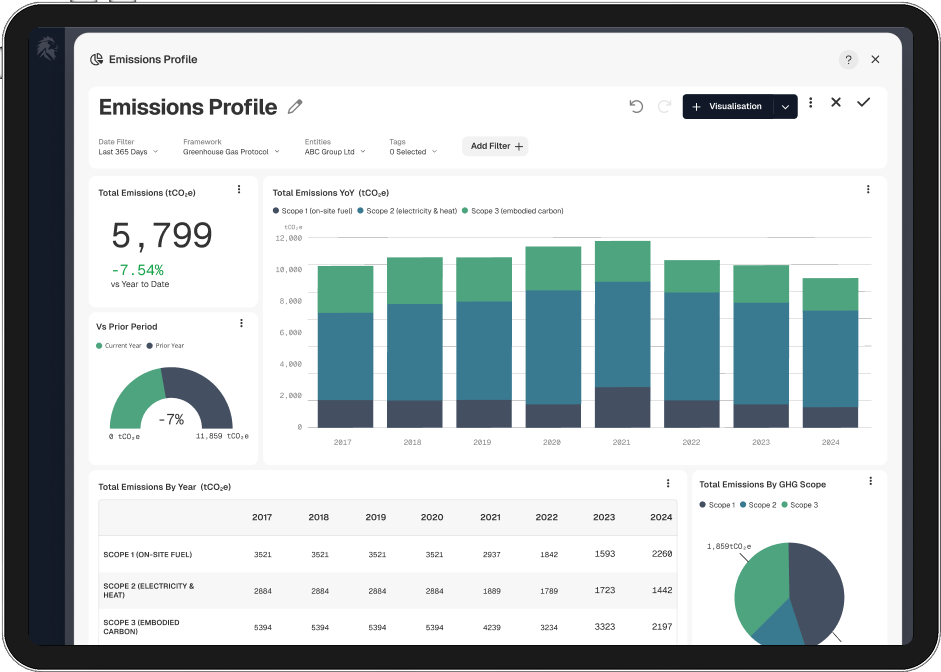
Auditors care about a documented chain of evidence from source document to reported figure. They want to see version control, a logged history of every change, the rationale recorded for each classification, and a clear calculation breakdown from raw data to final number. A polished dashboard counts for little if it cannot produce that.
A platform can produce a beautiful dashboard and still leave you exposed if it cannot answer the auditor’s questions with documentation. When we built BraveGen, our founding product manager was an auditor, so traceability and easy audit processes were designed in from the start rather than bolted on. The practical test for any tool you are evaluating: ask the vendor to show you exactly how a single number on the final report traces back to the invoice or meter reading it came from. If that demo is smooth, the tool is doing the job.
For a fuller breakdown of what assurers ask for and the evidence to have ready, see our ASRS audit guide.
The real job: what does a sustainability manager’s week actually look like?
Software lists rarely describe the person using the software. But the fit between the tool and the job is what determines success. Here is the reality for the mid-market and enterprise sustainability managers we work with.
The role has shifted towards compliance. Since climate statements became mandatory and directors picked up legal liability (with fines and, in serious cases, personal consequences), a lot of the week now goes to reporting up: quarterly updates to leadership, the CEO, and sometimes the board. But the managers we talk to do not want to stop at compliance. They want to use the same data to make the business case: cutting operating costs through energy and efficiency gains, building resilience against climate and supply-chain risk, and turning a credible sustainability position into revenue and access to capital. As one manager put it, the challenge is “how to make sure that we are not just ticking boxes and actually putting strategy and activity first.” The job is to clear compliance with the least drag on the business, then get on with the work that pays for itself.
Then there is audit season. The recurring phrases we hear are telling: “a lot of it is spreadsheets and data,” “following up and chasing people,” “not having to work through heavy, slow, horrible spreadsheets.” The teams are small, often two full-timers plus a part-time analyst borrowed from finance. When the software does the calculation and stores everything sensibly, the feeling people describe is “relief.” When it is hard to use, it is “frustration,” and when an audit question lands and the evidence is not there, it is “fear.”
Teams several years into mandatory reporting describe the work changing shape. Audit stops being one end-of-year scramble and becomes an ongoing cycle.
It’s less of a timeline, it’s more of a cycle. We’re almost constantly preparing for audit.
Claire Pont, Environment and Sustainability Manager, Spark New Zealand
So the real brief is simple. Take the data-collection grind off the team. Make the audit defensible without a last-minute scramble. Give back the hours so the people responsible for emissions can actually work on reducing them: the risk, the strategy, the projects with operating divisions. The best tool is the one that, in the words of one manager, “becomes another team member.”

The best carbon accounting software platforms in Australia, compared
We reviewed the platforms most active in the Australian market as of 2026, focused on mandatory ASRS and AASB S2 reporting. Several of these are good, they suit different organisations, and the right answer depends on your size, your data, and whether you carry a property portfolio. Here is where each fits.
| Platform | Best suited to | Notable strength |
|---|---|---|
| BraveGen | Mid-market and enterprise, especially with large property portfolios, reporting across ANZ | Auditor-built traceability; dual ASRS and NZ CRD coverage; Building Optimisation |
| Avarni | Finance-led teams focused on Scope 3 and supplier engagement at scale | Machine-learning Scope 3 analysis and large-dataset handling |
| Unravel Carbon | Organisations seeking an AI-based approach across the workflow | Agent-style automation and a large emissions-factor library |
| Greenbase | Mining, energy and utilities with complex NGER obligations | Long-standing NGER and regulatory reporting depth |
| Sumday | Accountants and advisors delivering reporting for clients | Built around accounting workflows and advisor delivery |
| NetNada / Climate Zero / Trace | Small and medium businesses starting out, or brand-led climate action | Accessibility, quick set-up, customer-facing storytelling |
| Pathzero | Investors and private equity assessing financed emissions | Portfolio-level emissions exposure and disclosure |
| Generate Zero | Banks and financial institutions reporting financed emissions, especially in NZ | PCAF-accredited financed emissions; strong ANZ banking adoption |
| Workiva Carbon | Large multinationals consolidating ESG with financial disclosure | Integration with broader financial and ESG reporting |
| Watershed | Large global multinationals with complex value chains and mature in-house teams | Enterprise-grade automation, data lineage, multi-framework global reporting |
| Persefoni | Financial institutions needing investor-grade, PCAF-aligned disclosure | Financed emissions and assurance-grade carbon ledger |
Where BraveGen fits, and where it does not
We built BraveGen for mid-market and enterprise organisations carrying real reporting obligations across Australia and New Zealand, and we are the strongest fit when two things are true: you need audit-grade reporting you can defend, and you have a sizeable owned or tenanted property portfolio.
The substance behind that: more than two decades of carbon accounting experience, billions of sustainability data rows processed for leading ANZ businesses, and hundreds of Big 4-tested, assurance-grade audits supported. Because our founding product manager was an auditor, transparency and traceability are defaults, not add-ons. We cover AASB S2 and ASRS for Australia and the Climate-related Disclosures regime for New Zealand, which matters if you report on both sides of the Tasman. And our Building Optimisation product solves a problem most carbon tools ignore: capturing utility data from difficult building systems and hard-to-reach tenant meters, then making it actionable. Clients including commercial real estate services firm Colliers, asset manager Centuria and retirement living leader Levande use the suite for exactly this.
Where we are not the right fit: if you are a small business doing a first voluntary footprint for your website, a lighter, cheaper tool like Trace or Climate Zero will get you there faster. If your need is purely financed-emissions disclosure, Pathzero and Generate Zero are purpose-built for that. We will tell you that upfront. The value shows up most for teams with real complexity to manage.

What about the global enterprise platforms?
Three global names come up in most enterprise shortlists, and they are strong platforms, so it is worth being clear about when they make sense for an Australian reporter.
- Watershed is a US-built enterprise platform (named a leader in the 2026 Verdantix Green Quadrant) suited to large multinationals with complex global value chains, mature in-house sustainability teams, and many systems to integrate. If your footprint is dominated by a sprawling international supply chain and you report across CSRD, SEC, and ISSB as well as ASRS, it is a serious option.
- Persefoni is built for financial institutions and investor-grade disclosure, with a PCAF-aligned engine strong on financed emissions. It overlaps with Generate Zero and Pathzero on the finance use case.
- Workiva Carbon (in the table above) suits finance-led organisations consolidating carbon with broader financial and ESG filings in one assured system.
The trade-off with the global platforms is local fit. They are built for the world, not for the specifics of AASB S2, NGER, and New Zealand’s CRD regime, and their pricing and implementation are pitched at large global programmes. For an ANZ-headquartered mid-market or enterprise reporter, especially one that reports on both sides of the Tasman or runs a property portfolio, a platform built for this market will usually mean less customisation, faster local support, and a team that already knows what an Australian auditor will ask. That local depth is the reason we exist, and it is the main thing to weigh a global platform against. If you operate at global-multinational scale, shortlist Watershed; if you are anchored in ANZ, weigh whether you are paying for global scope you will not use.
Which carbon accounting software should you choose?
Choose based on your reporting obligation, your data sources, and your team’s capacity, in that order. A short decision guide:
- Mandatory ASRS reporter with property assets, reporting across ANZ: shortlist platforms with auditor-grade traceability and building data capture. This is our home ground, so include BraveGen.
- Finance-led team where Scope 3 and supplier data is the whole game: look closely at Avarni and Unravel Carbon for supplier engagement and automation depth.
- Heavy NGER obligations in mining, energy or utilities: Greenbase has the regulatory depth for complex facility reporting.
- Advisor or accountant reporting on behalf of clients: Sumday is built for that delivery model.
- Small business or voluntary footprint: NetNada, Climate Zero or Trace will get you started without enterprise overhead.
- Investor or financial institution assessing financed emissions: Pathzero is purpose-built for portfolio exposure, and Generate Zero is a strong fit for banks and lenders needing PCAF-accredited financed emissions, particularly in New Zealand. Persefoni is the global equivalent for investor-grade financial-sector disclosure.
- Large global multinational with complex international value chains: shortlist a global enterprise platform like Watershed, and weigh its scope and cost against a local platform if most of your obligation sits in ANZ.
Whatever you shortlist, run the same three tests in every demo. Ask them to trace one final number back to its source document. Ask how Scope 3 gaps are handled and disclosed. Ask what your team will still do by hand after go-live. The answers will tell you more than any feature list, including this one.
We significantly increased the number of tenants we were collecting data for, at the same time as we brought BraveGen on. So I’m spending less time on it than before, while covering significantly more tenant data. It’s a fraction of the time spent requesting data from tenants.
Auditors can explore the BraveGen system themselves. The questions we get now are about calculation methodology and bespoke things like passenger commuting, not ‘where’s this invoice, what was that?’ That’s been one of our biggest benefits.
BraveGen is a great product. It’s been great for us. We’re loving it.
Josh McIvor, Sustainability Manager, Wellington Airport
Frequently asked questions
What is the best carbon accounting software for ASRS in Australia?
There is no single best platform for every organisation. The right choice depends on your reporting group, your data sources, and whether you carry a property portfolio. For mandatory AASB S2 reporters that need audit-grade traceability and report across Australia and New Zealand, BraveGen is a strong fit. Finance-led teams focused on Scope 3 often shortlist Avarni or Unravel Carbon, and small businesses doing a first footprint are usually better served by a lighter tool such as Trace or Climate Zero.
Do I legally need carbon accounting software for AASB S2?
Software is not legally mandated, and you can produce an assured AASB S2 disclosure from spreadsheets. The catch is cost. The version control, granular audit trails, and documented chain of evidence from source document to reported figure that assurance requires are labour-intensive and expensive to maintain by hand. Given that directors carry legal liability for the accuracy of disclosures, most large entities move to purpose-built software to cut that cost and risk.
When does my organisation have to start ASRS reporting?
ASRS is phased. Group 1 entities report from financial years starting on or after 1 January 2025, Group 2 from 1 July 2026, and Group 3 from 1 July 2027. You can also be pulled in automatically if you already report under NGER, regardless of size. Scope 3 emissions reporting becomes mandatory from your second reporting period.
What is the difference between ASRS and New Zealand’s CRD regime?
Both lift climate disclosure standards, but ASRS is modelled closely on IFRS S1 and S2 and is more detailed and prescriptive, with broader scope and a phased move toward reasonable assurance and director liability. New Zealand’s Climate-related Disclosures regime is more principles-based and climate-specific. If you report on both sides of the Tasman, software that handles both regimes saves running two processes.
What should I look for in an audit trail?
You want every reported figure to trace back to its source document, with every change logged, a recorded rationale for each emissions classification, and a clear calculation breakdown from raw data to final number. In any demo, ask the vendor to trace a single final number all the way back to the invoice or meter reading it came from. If that is smooth, the audit trail is real.
About the author. This guide was written by the BraveGen team. BraveGen has more than two decades of carbon accounting experience and supports hundreds of Big 4-tested, assurance-grade sustainability audits for mid-market and enterprise organisations across Australia and New Zealand. We make Carbon Accounting and Building Optimisation software built for ASRS, AASB S2, and New Zealand’s CRD regime.